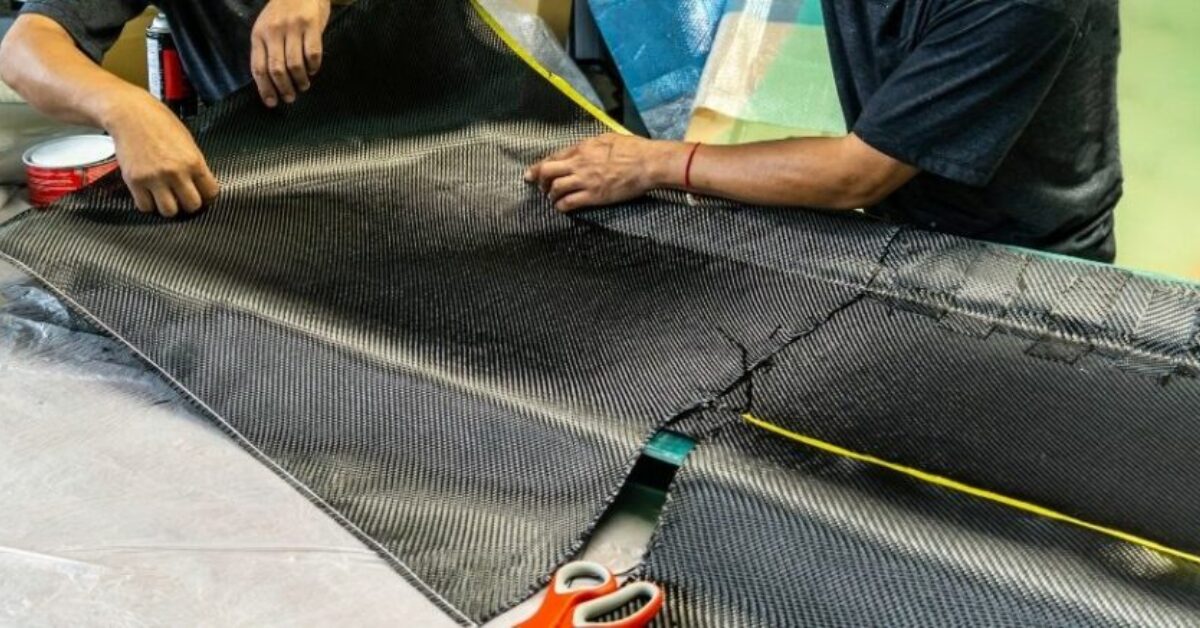
Modern automotive customization uses a wide range of materials to balance appearance, weight, durability, and manufacturing cost. Among the best-known composite reinforcements are carbon fiber and aramid fibers, including Kevlar. Both can be used in advanced applications, but they are not interchangeable in every situation.
Understanding their differences helps vehicle owners ask better questions when comparing aftermarket components. The right material depends on how the part is designed, the loads it must withstand, and the environment in which it will be used.
What Is a Composite Material?
A composite combines two or more materials to create a product with properties that differ from those of its individual ingredients.
In many fiber-reinforced composites, strong fibers are embedded in a resin matrix. The fibers carry much of the applied load, while the matrix holds them in position and transfers stress between them.
The final performance depends on more than the name of the reinforcement. Fiber orientation, resin selection, manufacturing quality, thickness, and the shape of the finished part all influence its behavior.
Understanding Carbon Fiber
Carbon fiber consists of very fine carbon-based filaments that are processed into reinforcing fibers. These fibers can be woven into fabric or arranged in other patterns before being combined with a suitable resin.
Carbon fiber composites are widely valued for their high stiffness and strength-to-weight potential. Their appearance is also popular in automotive design, particularly when the woven surface is visible beneath a clear finish.
Common Automotive Applications
Carbon fiber may be used in body panels, interior trim, mirror covers, aerodynamic accessories, and certain structural applications.
The material’s performance depends on the specific construction. A decorative panel and an engineered structural component may both contain carbon fiber but serve very different purposes.
Buyers should therefore evaluate the complete product rather than assuming that all carbon fiber parts have identical mechanical properties.
Advantages and Limitations
Carbon fiber composites can provide high stiffness at relatively low weight. However, they can be expensive to manufacture and may be vulnerable to particular types of impact damage.
Repair requirements depend on the component’s design and the severity of the damage. A cracked or delaminated composite part should not automatically be treated as a cosmetic issue, especially if it carries a structural load.
Understanding Kevlar and Aramid Fibers
Kevlar is a well-known brand of para-aramid fiber. Aramid fibers are valued for their tensile strength, impact-related characteristics, and resistance to certain forms of damage.
They are used in a variety of applications, including protective equipment, industrial products, and selected composite structures.
How Aramid Composites Behave
Aramid fibers can offer useful toughness and energy-absorption characteristics. Their behavior differs from that of carbon fiber, which is commonly selected when high stiffness is a priority.
Aramid composites can be more difficult to cut, sand, and finish cleanly. They may also be sensitive to certain environmental conditions, so the resin system and protective finish matter.
As with carbon fiber, the performance of an aramid-based component depends on the complete design and manufacturing process.
Carbon Fiber Versus Kevlar
The choice between these materials should begin with the component’s intended purpose.
Carbon fiber is frequently selected for stiffness, dimensional stability, weight-conscious design, and appearance. Aramid fibers may be selected where toughness and impact-related properties are important.
Neither material is universally superior. A material that performs well in one loading condition may be less suitable in another.
Strength Is Not a Single Property
The word “strength” is often used broadly, but engineers distinguish between tensile strength, compressive strength, stiffness, impact resistance, fatigue behavior, and other properties.
A material can perform exceptionally well under tension but behave differently under compression or repeated impacts. Composite performance also varies according to fiber direction and the quality of the resin bond.
For this reason, comparisons should refer to the relevant property and the specific test conditions rather than relying on a single general claim.
Weight and Cost
Both materials can be used in lightweight composites, but the finished component’s weight depends on the entire construction.
Manufacturing processes, labor, resin systems, finishing, and production volume influence cost. A hybrid composite that combines carbon and aramid fibers may offer a useful balance for certain applications, but it also introduces design and manufacturing considerations.
The lowest-priced product is not necessarily the best value if its construction or intended use is unclear.
What Are Hybrid Composites?
Some components combine different reinforcement materials to take advantage of complementary characteristics.
For example, a hybrid laminate may use carbon fiber in areas where stiffness is important and aramid reinforcement where impact-related properties are a priority. The exact benefits depend on the laminate design and the loads expected in service.
Hybrid construction is not automatically better than a single-material design. It must be engineered for the intended application, and the manufacturer should be able to explain the product’s purpose.
Choosing Automotive Parts Responsibly
When comparing aftermarket components, start with the vehicle application and the function of the part. Cosmetic trim has different requirements from a component that supports a load or influences vehicle safety.
A product listing should clearly identify its material, intended use, compatibility, installation method, and care requirements.
For anyone researching carbon fiber Kevlar products and material options, it is important to distinguish between a component made from a genuine composite and one that simply imitates the visual appearance of a woven material.
Ask the supplier whether the part uses carbon fiber, aramid fiber, a hybrid laminate, a surface overlay, or a printed finish. Clear material descriptions make comparisons more meaningful.
Inspect the Finished Product
Check the visible surface for obvious defects, uneven finishing, exposed fibers, or damaged edges. However, appearance alone cannot confirm internal construction or structural quality.
For components used in safety-critical or high-load applications, request relevant technical documentation and professional assessment. Avoid relying on decorative appearance as evidence of engineering performance.
Manufacturing and Quality Control
Composite manufacturing can involve hand layup, vacuum-assisted processes, resin infusion, and other techniques. Each method has different requirements and potential limitations.
Quality control helps reduce problems such as voids, inconsistent resin distribution, delamination, and dimensional variation.
The appropriate process depends on the product’s geometry, intended use, production volume, and performance requirements. A manufacturer should select a process that suits the part rather than assuming that one method is ideal for every application.
Maintenance and Repair Considerations
Composite components should be cleaned using products suitable for their resin system and surface finish. Avoid harsh chemicals or abrasive tools unless the manufacturer explicitly approves them.
Inspect components after significant impacts or signs of unusual stress. Cracks, delamination, exposed fibers, or changes in shape may require professional evaluation.
Repairs should be performed using appropriate materials and procedures. A cosmetic patch may not restore the original performance of a structural composite, so the repair method must match the component’s function.
Frequently Asked Questions
1. Is carbon fiber stronger than Kevlar?
There is no universal answer. Carbon fiber and aramid fibers have different mechanical characteristics. The better option depends on the property being evaluated, the direction of loading, and the design of the finished composite.
2. Can carbon fiber and Kevlar be used together?
Yes. Hybrid composites can combine the materials in a single laminate. Their performance depends on fiber arrangement, resin system, manufacturing quality, and the requirements of the intended application.
3. Is a visible woven pattern proof that a part is genuine carbon fiber?
No. A woven appearance can be created with overlays, printed designs, or other finishes. Buyers should confirm the material and construction details with the supplier.
Conclusion
Carbon fiber and Kevlar-based aramid composites offer different characteristics that can be useful in automotive and industrial applications. Carbon fiber is often valued for stiffness and weight-conscious design, while aramid fibers can provide useful toughness and impact-related properties. Understanding the specific requirements of a component, verifying its construction, and evaluating reliable technical information are the best ways to make an informed material choice.
